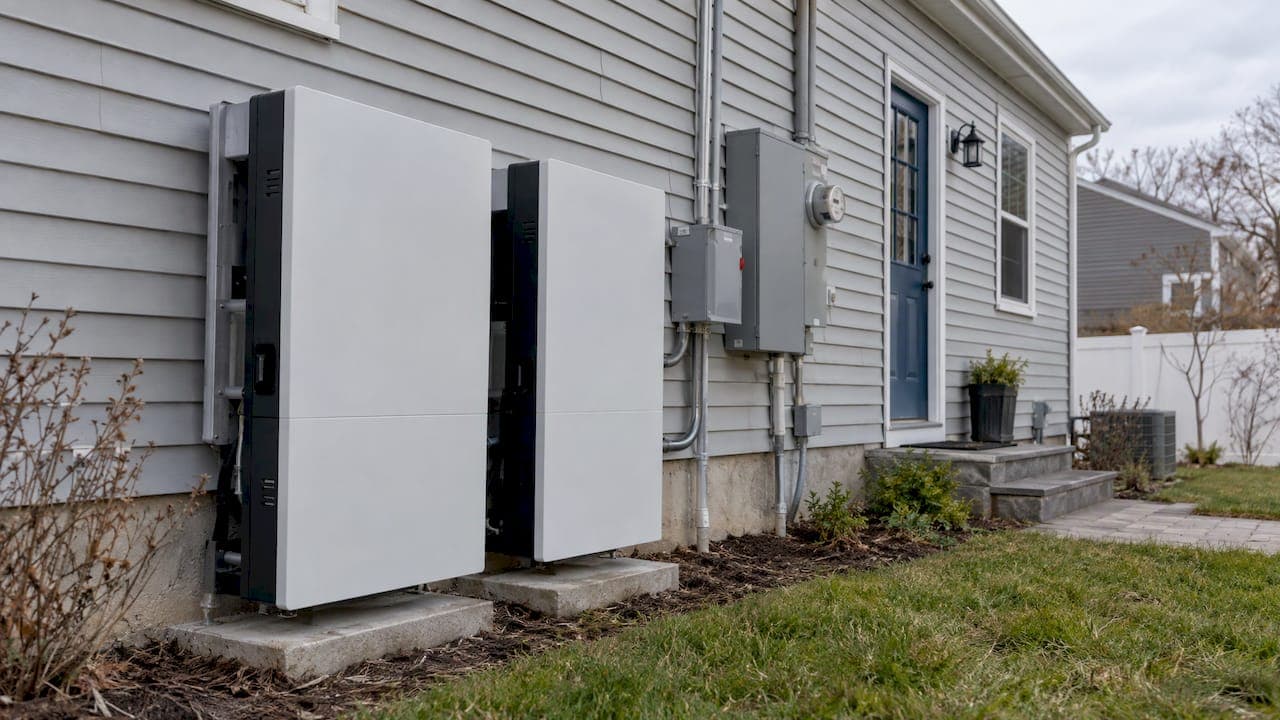
A Delaware home becomes less dependent on the grid when solar panels, a battery and a clear backup plan are designed together. Panels produce power during the day. The battery stores part of it and supplies the circuits you choose at night and during outages. The path runs in six steps: review your usage, choose your backup loads, size the battery, confirm utility requirements, install, and commission. This guide walks through each step for Delaware homeowners. Current RS designs and installs these systems, and no design can promise complete off-grid operation.
TL;DR
- Solar alone usually shuts off during a grid outage. Solar with a battery can keep selected loads running, including at night.
- Battery size comes from three numbers: the energy you need (kWh), the power you need at once (kW), and motor-starting surge.
- Your electric utility sets the interconnection process and decides which incentives apply, so confirm it before design.
- Adding a battery to existing solar is often possible, but the inverter type decides which battery connection works best.
- Current RS reviews your usage, utility and project timing in a personalized plan before any equipment is chosen.
Table of Contents
- What energy independence means for a Delaware home
- Step 1: Review your usage before choosing equipment
- Step 2: Decide what must keep running in an outage
- Step 3: Size the battery for energy, power and surge
- Step 4: Plan for winter, clouds and long outages
- Step 5: Confirm Delaware utility requirements first
- Adding a battery to existing solar
- Batteries and generators
- What drives installed cost in Delaware
- From contract to commissioning: the project timeline
- Get a plan built around your home
- FAQ
- Sources
What energy independence means for a Delaware home
For most Delaware homeowners, energy independence is a matter of degree. It means producing a meaningful share of your own electricity, using less utility power at expensive times, and keeping essential circuits running when the lines go down. It does not mean disconnecting from the grid. Most Delaware homes stay connected to their utility, whether that is Delmarva Power, Delaware Electric Cooperative or a municipal utility, and use the connection as a supplement.
This distinction matters for planning. A grid-connected home with solar and storage can cover its essential loads through many outages and shift its use away from peak hours. A fully off-grid home needs a much larger battery, a backup generator or more, and strict load management. Current RS does not guarantee off-grid autonomy for any home. The plan below aims at reduced grid reliance and dependable outage protection.
Step 1: Review your usage before choosing equipment
Every sizing decision starts with how your household uses electricity. Gather twelve months of utility bills. They show total monthly kWh, and your utility account may also show daily or hourly data if you have an advanced meter.
Look for four things:
- Annual and monthly kWh. This sets how much solar the roof needs to produce.
- Evening and overnight use. This is the energy a battery will supply once the sun is down.
- Large loads. Electric heat pumps, electric water heaters, well pumps, electric vehicle chargers and central air conditioning drive both the energy and the power you need.
- Future changes. A planned EV, heat pump or addition changes the design.
The load profile also tells you whether the roof can realistically support your goal. Roof orientation, shading and available space limit how much a system can produce, so a site review is part of this step.
Step 2: Decide what must keep running in an outage
The second decision is the backup scope. There are two common approaches, and the choice drives both cost and runtime.
Essential-loads backup powers a dedicated set of circuits: refrigerator, lights, internet, phone charging, a furnace blower or well pump, and perhaps a few outlets. This is the most common starting point because it keeps the battery small and the runtime long.
Whole-home backup powers every circuit. It suits homes where the owner wants normal living during an outage, but it needs more battery power and energy, and it often needs load management that sheds or prioritizes appliances so that simultaneous loads do not exceed what the system can deliver. Current RS describes this option on its whole-home backup page.

A useful exercise is to walk through the house and list each appliance with its wattage. Mark each one as essential, nice to have, or not needed in an outage. Large 240-volt loads such as electric dryers, electric ranges and central air conditioners are the usual candidates to leave off the backup panel or to manage with controls.
Step 3: Size the battery for energy, power and surge
Battery sizing uses three measurements, and a system has to satisfy all three.
| Measurement | What it means | Why it matters |
|---|---|---|
| Energy (kWh) | How much electricity the battery stores | Sets how long your loads run |
| Continuous power (kW) | How much the battery and inverter can deliver at once | Sets how many loads run together |
| Surge power | Short burst when motors start | Decides whether a well pump or air conditioner will start |
Sizing guidance from professional battery sizing resources makes the same point: energy, continuous power and surge, including motor starting, all have to be accounted for. A battery with plenty of kWh can still fail to start a well pump if its inverter cannot supply the surge.
How runtime works
Runtime is stored energy divided by the load you are running. A battery running only a refrigerator and lights can last far longer than the same battery running a heat pump. The Department of Energy's Building America program notes that a battery system serving some, but not all, home circuits can last about a day before needing recharge, and that runtime varies by system. Solar recharging during the day extends that, as long as the panels are producing.
Research from Lawrence Berkeley National Laboratory gives a useful sense of scale. In its U.S. county-level work, a 10-kWh residential solar-plus-storage system met a limited set of critical loads in most counties in every month, while average performance fell to 86% of critical load when heating and cooling were included. In a separate study, average critical-load service fell from 100% for a one-day outage to 92% for a 10-day outage across U.S. counties and months, because daily solar recharging softens the decline. These are national averages, not Delaware predictions. Your own result depends on your loads, your roof and the weather during the outage.

Build in a margin
Batteries lose some usable energy to conversion, cold and age. One manufacturer's design guide suggests adding 15 to 25 percent for efficiency, cold weather and aging when estimating needs. Treat that as a planning heuristic, and ask your installer to show the assumptions behind the proposed capacity.
Step 4: Plan for winter, clouds and long outages
Delaware gets cold, cloudy stretches and the occasional storm. Solar and storage still work in these conditions, but expectations should be realistic.
The Department of Energy reports that PV modules generally operate more efficiently in cold weather, but snow and ice can limit production. Cloud cover matters during outages as well. Research summarized by The Conversation notes that after Hurricane Florence, cloudy skies persisted for three days and diminished or stopped solar production.
Winter performance also depends on how your home is heated. The LBNL county-level assessment found that winter backup performance is lowest where electric heat is common, and that thermostat settings and air leakage changed results substantially. In practical terms:
- If you heat with gas, oil or propane, a modest battery can keep the blower, controls and circulation pump running.
- If you heat with a heat pump or electric resistance, whole-home backup needs far more capacity, or you should plan to run only part of the heating load during an outage.
- Lowering the thermostat during an outage and sealing air leaks both stretch the battery.
A long outage in cold, cloudy weather is the hardest case. A system designed around essential loads, with load management, handles it better than one that tries to carry everything.
Step 5: Confirm Delaware utility requirements first
Utility rules are where Delaware projects differ most from generic guides. The utility serving your address determines the interconnection process, the net metering terms and which incentives you can use.
Delaware's main electric providers are Delmarva Power, Delaware Electric Cooperative and municipal utilities. Their processes differ:
- Delmarva Power customers. Under the state's Solar + Storage Pilot Program, applications go through the Green Grant Delaware portal, and battery projects must follow DPL's standard interconnection process.
- Delaware Electric Cooperative members. The cooperative runs its own Beat the Peak battery program, in which batteries can discharge stored energy during high-demand alerts to reduce reliance on utility power at peak times.
- Municipal utilities. Requirements are set locally. Smyrna, for example, reviews site plans, inverter datasheets and single-line drawings, then checks warning labels and bidirectional meter operation after installation.
Permits are also local. A project typically needs a building or electrical permit from the county or municipality, and an inspection before the utility grants permission to operate. Your installer should handle the paperwork, but you should ask who submits each application and who tracks it.
Incentives, briefly
Incentives can lower the net cost, but they are a supporting factor and should never drive the design. The state's Solar + Storage Pilot Program offers residential battery grants of $250 per kWh, capped at $6,000, effective August 11, 2026. DNREC states that Green Energy Program rebates are open only to Delmarva Power customers, and applicants must meet the existing Green Energy Program guidelines for solar. Funding, caps and eligibility can change, and approval is never guaranteed, so confirm the current terms on the official page before you sign. Current RS offers a Delaware SHINES eligibility review and answers common questions in its Delaware SHINES battery FAQ.
Adding a battery to existing solar
If your home already has solar, you may not need a new system. A battery can often be added, and the answer depends on your existing inverter.
The Building America program explains that AC-coupled batteries have built-in inverters, while DC-coupled batteries are often the least-cost, most power-efficient option for an existing central-inverter system. Microinverter systems and optimizer-based systems each have their own compatible battery paths.
Before a retrofit, an installer should check:
- The make, model and age of your inverter or microinverters.
- Whether the main service panel can take a backup subpanel or gateway.
- Whether the existing solar is under a warranty or a utility agreement that the retrofit could affect.
- Whether the inverter is near the end of its life and should be replaced at the same time.
Current RS covers the process in its guide to adding a battery to existing solar and compares options in its article on Tesla, Enphase and SolarEdge battery storage. If an aging inverter is the weak link, the solar inverter replacement page explains that service.
Batteries and generators
Many Delaware homeowners already own a portable or standby generator. A battery does a different job. Building America notes that battery systems can be recharged by solar, while fossil-fuel generators need fuel and periodic maintenance. Batteries also switch over without fuel deliveries and run quietly indoors-adjacent equipment such as the electrical panel area.
Some homeowners keep a generator as a second layer for very long outages and add a battery for everyday resilience and peak-hour use. Current RS compares the two in its article on battery storage versus a generator in Delaware.
What drives installed cost in Delaware
Current RS does not publish fixed prices, because installed cost depends on the specific home. Quotes vary with these factors:
- Solar array size, which follows your annual usage and roof capacity.
- Battery capacity and number of units, set by your backup scope and runtime goal.
- Inverter and battery architecture, including whether you are retrofitting existing solar.
- Electrical work, such as a service panel upgrade, a backup subpanel or a gateway.
- Roof condition. If the roof needs work before panels go on, the project sequence changes.
- Permits, interconnection and inspection fees set by your local jurisdiction and utility.
- Incentives, if you qualify, which reduce net cost but do not change the gross price.
When you compare quotes, compare the same scope: kWh of storage, kW of continuous output, which circuits are backed up and what is excluded. Two quotes with different totals often cover different systems.
From contract to commissioning: the project timeline
Once the design is agreed, a typical project moves through these stages. Durations vary by utility queue, permit office and equipment availability, so ask your installer for a schedule specific to your address.
- Home energy review and design. Usage, loads, roof and electrical panel are assessed, and the backup scope is set.
- Proposal and contract. The proposal lists equipment, capacity, backed-up circuits and the work included.
- Permit and utility applications. Building or electrical permits are filed, along with the interconnection application and any incentive application. For Delmarva Power battery projects, interconnection follows DPL's standard process.
- Installation. Panels, inverters, battery, gateway and backup subpanel are installed and wired.
- Inspection. The local authority inspects the work. Some municipalities also check labeling and meter operation.
- Permission to operate. The utility approves the connection. Do not switch the system on before it does.
- Commissioning. The installer tests grid-tied operation, simulates an outage to confirm that backed-up circuits transfer, configures monitoring and walks you through the app and the battery's reserve settings.
Ask to see the outage transfer test during commissioning. It is the moment you confirm that the plan works as designed.
Get a plan built around your home
Current RS designs and installs residential solar, battery storage and coordinated home power systems for Delaware homeowners. Its service pages cover battery backup, hybrid energy systems and residential solar installation.

The starting point is a personalized review. Have these ready: your ZIP code, your electric utility, whether you own the home, whether you already have solar, your recent usage and when you want the project done. From there, Current RS can review eligibility, compare system options and outline the steps for your address. Get Your Home Energy Independence Plan.
FAQ
Can solar panels alone power my Delaware home during an outage?
Generally no. Residential solar panels without storage switch off when grid power cuts out, for safety reasons. Adding a battery and an inverter configured for backup lets the system supply selected circuits, including at night.
How big a battery do I need?
It depends on which circuits you back up, how long you want them to run and what motors must start. Size for energy in kWh, continuous power in kW and surge. A load review of your home gives the answer for your situation.
Can I add a battery if I already have solar?
Often yes. The right connection depends on your inverter type and your electrical panel. An installer should inspect the existing equipment before recommending a battery and check whether the inverter should be replaced at the same time.
Will a battery make my home completely off-grid?
No plan can promise that. Long cloudy winter outages, heavy electric heating and large loads can exceed what a battery supplies. A well-designed grid-connected system reduces grid reliance and protects essential circuits, with load management to stretch runtime.
Do Delaware incentives apply to every homeowner?
No. Eligibility depends on your utility and the program's current rules, and approval is not guaranteed. Check the official DNREC program page for current terms before you commit.
Sources
- Solar and Resilience Basics, U.S. Department of Energy
- Battery Backup Home System Design, EcoFlow
- How to Size a Home Battery: kWh, kW and Surge Power
- PV Battery Storage for Power Outages, Building America
- County-level assessment of behind-the-meter solar and storage, 2023
- Solar-plus-Storage for Providing Backup Power during Outages, 2022
- Solar Photovoltaic Hardening for Resilience: Winter Weather, U.S. Department of Energy
- Could solar and batteries power your home when the grid goes out?, The Conversation
- Solar + Storage Pilot Program Guidelines and Incentives, DNREC
- Green Energy Program, DNREC
- Beat the Peak With Batteries, Delaware Electric Cooperative
- Solar Power, Smyrna, DE