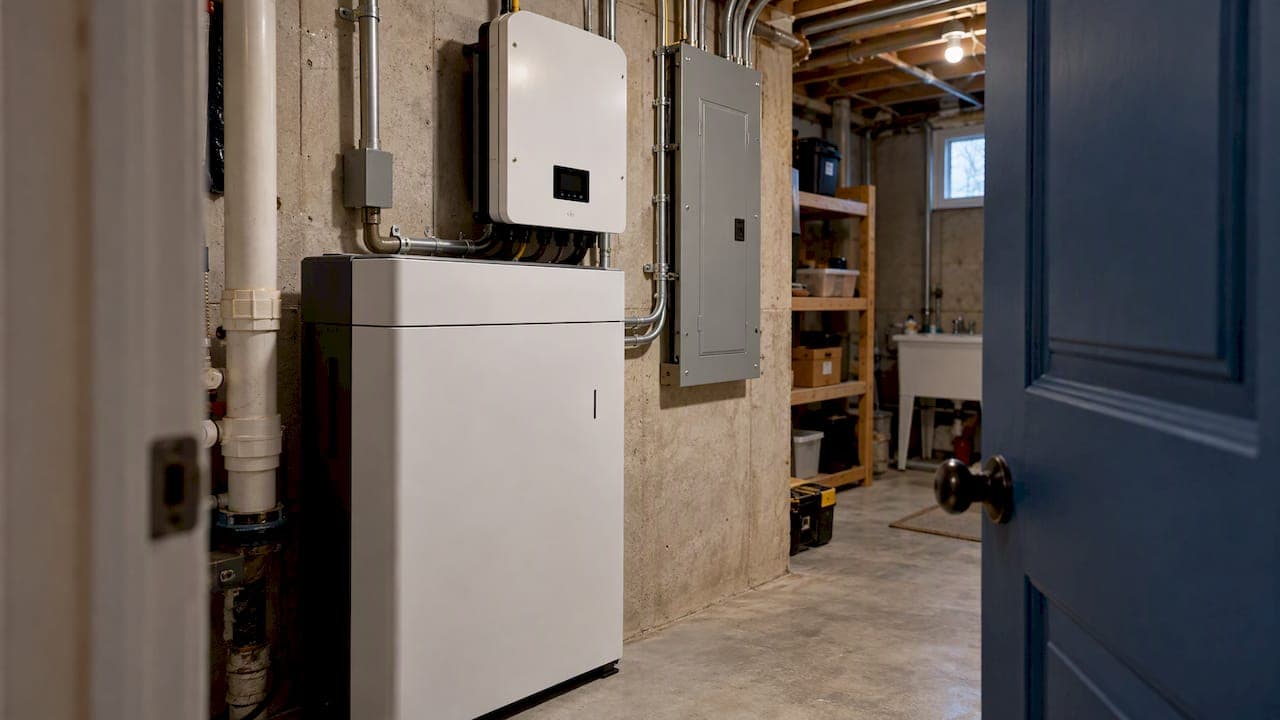
Solar and batteries can power a Delaware home through an outage and cut how much electricity you buy from the utility. Running a home year-round with no utility connection at all is a different goal. It takes a much larger system, more batteries and more cost. Most Delaware homeowners are better served by a grid-connected system with battery backup, designed around the loads they need most. Current RS designs and installs these systems for Delaware homes.
TL;DR
- Reduced grid reliance is realistic: solar produces power during the day and a battery shifts some of it to the evening and to outages.
- Full autonomy means sizing for the worst winter stretch, not the average day, so it costs far more than a grid-connected system.
- Solar panels alone generally shut off when the grid goes down. A battery and the right equipment are what keep the house running.
- Battery size comes from your loads and the hours you want to cover. Essential-circuit backup needs a smaller battery than whole-home backup.
- Delaware has a state grant for qualifying batteries. Eligibility and funding are set by the state, and approval is never guaranteed.
Table of Contents
- Reduced grid reliance versus year-round autonomy
- Why solar panels alone do not keep the lights on
- Essential-circuit backup or whole-home backup
- How to size a battery for your home
- Seasonal constraints on a Delaware system
- Reduce your load before you size the system
- Adding a battery to existing solar
- Utility and incentive requirements in Delaware
- What an installed system costs
- A practical path for Delaware homeowners
- Start with a home energy review
- FAQ
- Sources
Reduced grid reliance versus year-round autonomy
These two goals are often treated as one. They are not.
Reduced grid reliance means the home stays connected to the utility. Solar covers part of daytime use. A battery stores some of that energy for evenings and holds power during an outage. The utility still fills the gaps, such as a long cloudy week in January.
Year-round autonomy means no utility connection is needed at any time. A stand-alone system of that kind must be sized to supply the home's entire load, with battery backup for nighttime and cloudy periods. The same source notes that batteries add cost and complexity to a system.
Current RS does not guarantee complete off-grid operation for any home. For a typical Delaware household that wants dependable power, the practical design is a solar-plus-storage system that stays tied to the grid and can run the house on its own when the grid fails.
| Goal | Grid connection | What the system does | Design driver |
|---|---|---|---|
| Lower grid purchases | Yes | Solar offsets daytime use, battery shifts some energy to evening | Your annual and daily usage |
| Outage protection | Yes | Battery powers selected circuits or the whole house when the grid is down | Backup loads and hours of runtime |
| Year-round autonomy | No | System supplies every load in every season | Worst-case winter production and the longest cloudy stretch |
Why solar panels alone do not keep the lights on
A common surprise: a home with solar panels still goes dark in a utility outage. The U.S. Department of Energy explains that residential solar systems generally depend on the grid and are designed to switch off when grid power cuts out. This protects utility workers repairing lines.
To keep power flowing, the home needs a battery and an inverter arrangement that can disconnect from the grid and operate on its own. This is often called islanding. During an outage, the battery supplies the home and the solar panels recharge it while the sun is up. At night the battery carries the load alone.
Essential-circuit backup or whole-home backup
Backup systems come in two main designs.
Essential-circuit backup powers a chosen group of circuits. Typical choices are the refrigerator, lights, internet, a furnace blower, a well pump and medical devices. A smaller battery can cover these for a long time.
Whole-home backup powers every circuit in the house. It needs more battery capacity and more inverter output, because large loads such as electric water heaters, dryers, ovens and central air can draw heavily at once. Current RS describes this option on its whole-home backup page, and the battery backup page covers the focused option.

The choice usually comes down to which loads you cannot do without, how long outages tend to last where you live, and budget. Homes that rely on powered medical equipment should plan those circuits first. Current RS covers this in its guide to battery backup for medical equipment at home.
How to size a battery for your home
Battery sizing is the step that decides how far the system takes you. The method is simple arithmetic.
- List what you want to run. Ready.gov advises taking an inventory of the items in your home that rely on electricity and planning for backup power.
- Multiply watts by hours. The Department of Energy guidance says to multiply each appliance's wattage by its hours of use in a day to find the storage you need in kilowatt-hours (kWh). Your monthly utility bill shows past household use.
- Add the totals. Sum the watt-hours for every device you want covered.
- Allow for usable capacity. Batteries do not deliver all of their rated capacity. University of Colorado Denver guidance says you generally get about 80% to 90% of rated capacity. Battery makers also set a depth of discharge. One manufacturer example shows that a 10 kWh battery limited to 80% provides 8 kWh of usable energy.
- Convert to runtime. Watt-hours divided by watts gives hours. A 1,000 Wh battery running a 10 W bulb lasts 100 hours, and the same battery running a 500 W load lasts about two hours before losses.
A worked example
Suppose you want a refrigerator, lights, internet and a furnace blower to run for a day. Say the combined need is 8 kWh. With a battery that delivers 80% of its rating, you would need a rated capacity of about 10 kWh. This is an illustration of the arithmetic, not a quote or a recommendation for any home. Real loads vary, and startup surges on motors matter as well as total energy. Current RS reviews actual usage and the equipment in the house before recommending a size.
Do not start from the average home
The U.S. Energy Information Administration reports that in 2022 the average U.S. residential customer purchased 10,791 kWh a year, about 899 kWh a month. That is a useful benchmark for grid purchases. It is not the load a backup battery must serve, and it says little about your home. Electric heat, a heat pump, an electric vehicle or a well pump can move your numbers well above or below it.
Seasonal constraints on a Delaware system
Winter is what separates "mostly solar" from "all solar." Days are shorter, the sun sits lower and cloudy spells can last several days. Snow can also cover panels. A system sized to cover your average day over the year can fall short in a December cloudy stretch, while producing more than you use in June.
That gap is the reason full autonomy gets expensive. To cover the worst week of winter without the grid, a home needs enough panels to recharge during poor sun and enough battery to carry several days. Those components sit mostly idle in summer. Staying grid-connected lets the utility cover rare shortfalls, so the system can be sized for your normal needs and your outage plan instead.
Winter also raises demand. Homes that heat electrically use more power exactly when solar produces the least. That is a design input for Current RS during a home energy review, along with roof orientation, shading and the age and type of the existing heating system.

Reduce your load before you size the system
The Department of Energy guidance puts efficiency first. Cutting consumption and using efficient appliances can cost less than buying a larger renewable system. Every kWh you stop using is a kWh you do not need to generate or store. Homes that heat with oil can also estimate winter heating oil needs ahead of the season, which helps show how much of the winter load is electric and how much is not.
Simple steps that shrink the backup load include moving the most critical circuits onto an essential-loads panel, choosing efficient refrigeration and lighting, and deciding which large loads can wait until the grid returns.
Adding a battery to existing solar
If your home already has solar, you may not need to start over. Battery storage can be added to an existing system using AC coupling, which lets you keep the existing solar inverter and wiring. The same guide notes that the solar inverter must be able to communicate with the battery inverter during an outage.
That compatibility is the first check an installer makes. Others include the age and model of the current inverter, the main electrical panel, the space for the equipment, and the utility interconnection requirements. Current RS explains the process in its guide to adding a battery to existing solar and compares common battery platforms in a battery brand comparison.
Utility and incentive requirements in Delaware
Delaware's Department of Natural Resources and Environmental Control (DNREC) publishes the rules for its Solar + Storage Pilot Program. According to the guidelines effective August 11, 2026, residential grants are $250 per kWh, capped at $6,000. The same document sets these requirements:
- The home must be served by Delmarva Power & Light (DPL).
- The applicant must own the battery, and the battery must have received interconnection approval within the previous year.
- Existing solar must have been approved for the Green Energy Program solar rebate.
- The project needs standard DPL interconnection.
- The battery must stay enrolled in an Active Dispatch program for 10 years.
- The system must be capable of islanding.
- Applications go through the Green Grant Delaware portal.
Programs change, funds are limited and approval is never guaranteed. Check the official DNREC page for current availability before you plan around a grant. Federal tax treatment of residential solar has also changed in recent years, so confirm what applies to your project with a tax professional. Current RS offers a Delaware SHINES eligibility review, and its Delaware SHINES FAQ answers common program questions. Current RS is a private contractor and has no government affiliation.
What an installed system costs
Current RS does not publish fixed prices, because the cost depends on the home. The main factors are:
- Battery capacity in kWh and inverter output in kW
- Essential-circuit versus whole-home backup, which affects panel work and equipment count
- Whether solar already exists and whether its inverter works with a battery
- Panel or electrical upgrades the home needs
- Roof condition, orientation and shading if new solar is part of the project
- Utility interconnection requirements
- Any state grant you qualify for, which lowers net cost but is not assured
A written proposal after a home review is the only way to get a real figure. Current RS also explains the cost factors in its guide to solar battery installation in Delaware.
A practical path for Delaware homeowners
Current RS designs systems around your priorities: lower reliance on the utility first, dependable outage protection second, and autonomy only where your loads and budget support it. The hybrid energy systems page describes solar-plus-storage that works with the grid, and the solar installation page covers new systems. For a broader view, read the guide to building energy independence with solar and battery storage in Delaware.
Start with a home energy review
Current RS reviews your ZIP code, electric utility, homeownership, existing solar, electricity usage and project timing. From that it recommends a system size, backup scope and next steps, including whether your project may fit the state program.

Get Your Home Energy Independence Plan
FAQ
Can a home run entirely on solar and batteries?
Yes, a stand-alone system can be sized to supply the whole load with battery backup for nights and cloudy periods. It costs more and is more complex than a grid-connected design. Current RS does not guarantee complete off-grid operation.
Will my solar panels work during a power outage?
Not by themselves. Residential solar systems generally switch off when the grid fails. A battery with islanding capability lets the home keep running.
How big a battery do I need?
Multiply the watts of each device you want to run by the hours of use, add them up, then allow for the usable share of the battery's rated capacity. Startup surges also matter. An installer should check your actual loads.
Can I add a battery if I already have solar?
Often yes. AC coupling lets you keep your existing inverter and wiring, provided the equipment is compatible. Your installer should confirm the inverter, panel and utility requirements first.
Sources
- Solar and Resilience Basics, U.S. Department of Energy
- Solar Electric Systems for Homeowners, Oklahoma State University Extension
- Battery Power for Your Residential Solar Electric System, U.S. Department of Energy
- Power Outages, Ready.gov
- Calculate Your Power Needs, University of Colorado Denver
- How to Right-Size Your Battery Storage System
- How to calculate your home battery needs, The Verge
- How much electricity does an American home use?, U.S. Energy Information Administration
- Battery Storage Guide for Homeowners, Solar United Neighbors
- Solar and Storage Pilot Program Incentives and Guidance, DNREC
- How to Estimate Winter Heating Oil Needs, FuelFinder